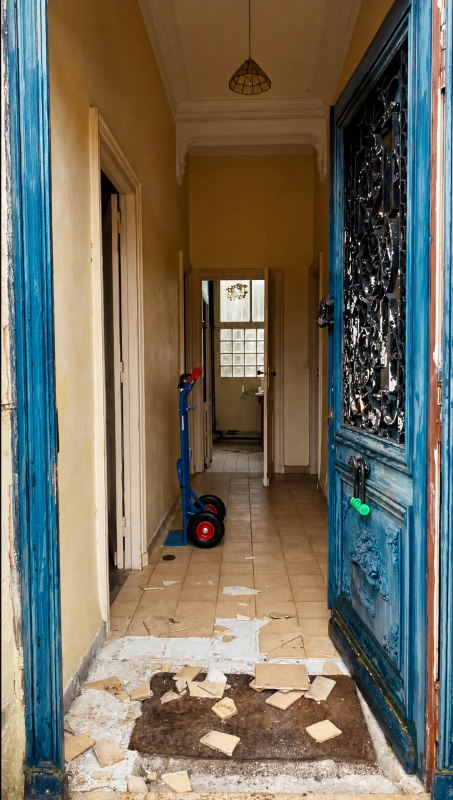
If you follow our journey restoring La Chartreuse, you probably already know that we are not the kind of people who only share the pretty moments. Yes, there are beautiful sunsets over the Bordeaux countryside, satisfying before-and-after reveals, and the occasional glass of wine on the terrace after a productive day. But there are also weeks that test every ounce of your patience, your planning, and your commitment to this enormous project. This fortnight was one of those weeks.
We have just released a new video documenting the chaos, and we wanted to use this post to go a little deeper into what actually happened, what we learned, and why the difficult stretches are just as important as the triumphant ones when you are renovating a historic property in France.
January Weather: When the Elements Conspire Against You
January in southwest France can be unpredictable at the best of times, but this year it felt like the weather had a personal vendetta against our renovation schedule. The rain was relentless. Not the kind of soft, intermittent drizzle that you can work around, but sustained, heavy downpours that turned the ground around La Chartreuse into a muddy obstacle course and made any exterior work completely impossible.
Then came the storm. We had been keeping an eye on the forecasts, but when the wind really picked up overnight, there was nothing to do but lie in bed listening to the shutters rattle and hope for the best. Thankfully, we escaped with minimal damage. A few displaced tiles, some debris scattered around the garden, and a healthy dose of anxiety. We know we were lucky. Neighbours in the area did not fare as well, and it was a stark reminder that when you own an old stone building, every severe weather event carries real risk.
The storm also reinforced something we think about constantly: the urgency of getting the roof properly insulated and sealed. La Chartreuse has stood for centuries, but centuries of exposure take their toll. Every week that passes without proper insulation and weatherproofing is another week the building is vulnerable. That knowledge is what keeps us pushing forward even when the conditions make everything harder.
For anyone considering a renovation project in this part of France, we cannot stress enough the importance of factoring weather into your timelines. The mild, sunny days that make the Nouvelle-Aquitaine region so appealing in summer are balanced by winters that can be genuinely harsh. We have learned to build significant buffer time into every phase of work that might be affected by rain or wind, and even then, we sometimes fall behind.
Installing Roof Supports: A Masterclass in Patience
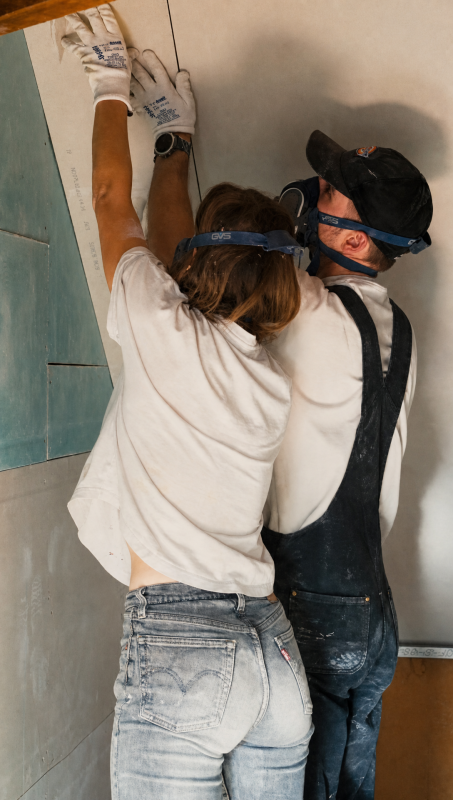
The main project this fortnight was installing the supports for the roof. These are the structural elements that will eventually hold the insulation and plasterboard, transforming the upper floor from an exposed, draughty space into proper, liveable rooms. On paper, the concept is simple: fix a framework of battens and supports to the underside of the roof structure, making sure everything is level and square so that the insulation sits properly and the plasterboard goes on smoothly.
In practice, it has been anything but simple.
The roof at La Chartreuse has four sloping planes, which immediately makes the geometry more complex than a standard pitched roof. Each plane meets the others at different angles, and every junction needs to be carefully measured and cut to ensure a clean transition. But the real challenge is not the geometry of the roof itself. It is the beams.
The Problem with Old Beams
The original roof beams at La Chartreuse are beautiful. They are thick, solid oak, and they have been holding this roof up for a very long time. But decades of bearing the weight of the roof, absorbing moisture, drying out, and absorbing moisture again have left them twisted, bowed, and far from straight. Some have sagged in the middle, others have rotated slightly on their axis, and a few have developed curves that would be charming in a piece of furniture but are maddening when you are trying to create a flat plane beneath them.
This means that we cannot simply fix our supports directly to the beams and call it done. Every single support has to be individually shimmed, packed, or adjusted to compensate for the irregularities in the beam above it. We are essentially creating a new, level framework that floats beneath the old, uneven structure, and the gap between the two is where the insulation will go.
To give you a sense of the complexity: we use a laser level to establish a reference plane, then measure the distance from that plane to each beam at multiple points along its length. Those measurements tell us how much packing material we need at each fixing point. Some points need a few millimetres of shim; others need several centimetres. Every measurement has to be precise, because even a small error compounds across the length of a beam and can leave you with a noticeable wave in the finished ceiling.
The Pace of Progress
After four solid days of work, we had completed roughly 25 percent of the total surface area. That might sound disappointing, but the first section is always the slowest because you are establishing your method, working out the kinks in your process, and solving problems you did not anticipate. We expect the pace to pick up as we move into the remaining sections, but even so, we are looking at several more weeks of work on this phase alone.
It is worth saying that this kind of slow, meticulous work is one of the things that separates a renovation that lasts from one that starts falling apart after a few years. We could move faster if we were less careful about getting everything level, but we would pay for it later with cracked plasterboard, gaps in the insulation, and a ceiling that looks wavy in certain light. Taking the time to do it properly now saves us from having to redo it later, and in a building this old, there are already enough problems to solve without creating new ones.
For fellow renovators, our advice is this: when you hit a phase of the project that is slow and painstaking, resist the temptation to rush. The invisible work, the stuff that gets hidden behind walls and ceilings, is the foundation that everything else depends on. No one will ever see our carefully shimmed supports, but everyone will see the smooth, even ceiling they create.
The Insulation Delivery Debacle
As if the roof supports were not keeping us busy enough, the universe decided to add a logistical challenge to the mix. Our insulation order, which we had expected to arrive in a few weeks, showed up early. Weeks early. And naturally, it arrived during one of the heaviest downpours of the month.
Now, if you have never handled building insulation, you might not immediately understand why this is a problem. Insulation, particularly the mineral wool type we are using, absolutely cannot get wet. Once it absorbs water, it loses its insulating properties, becomes heavy and difficult to handle, and can develop mould. An entire delivery of ruined insulation would have been a significant financial hit and a major delay to the project.
The Emergency Storage Operation
So there we were, standing in the rain, staring at a delivery truck full of insulation that needed to be somewhere dry immediately. The upstairs rooms where the insulation will eventually be installed were not ready. The ground floor was full of tools and materials. The only viable option was the cellar.
What followed was an impromptu and rather intense workout. Each bale of insulation is bulky and awkward to carry, and the route from the delivery point to the cellar involves navigating narrow doorways, a flight of stone steps, and several tight corners. We spent the better part of two hours hauling bales through the rain, down the steps, and into whatever space we could find in the cellar.
By the end of it, we were soaked, exhausted, and aching, but every single bale was dry and safely stored. It was not how we had planned to spend that afternoon, but in renovation, flexibility is not optional. Things rarely arrive when they should, weather rarely cooperates, and the ability to adapt quickly to unexpected situations is arguably the most important skill you can develop.
The lesson here, for anyone managing a renovation project, is to always have a contingency plan for material storage. We had vaguely discussed where the insulation would go when it arrived, but we had not seriously considered the possibility of it arriving weeks early during terrible weather. Now we plan storage solutions for every major delivery before we even place the order.
The Power of Small Wins
Here is something that does not get talked about enough in the renovation world: the psychological toll of difficult weeks. When you are spending day after day on painstaking, slow work, when the weather is miserable, and when unexpected problems keep piling up, it is remarkably easy to lose motivation. You start questioning your decisions. You wonder if you will ever actually finish. You look at the mountain of work still ahead and feel genuinely overwhelmed.
We have learned that the antidote to this is small wins. Deliberate, tangible accomplishments that you can point to and say, we did that, and it is good. They do not have to be big. They do not have to be part of the main project. They just have to be something that gives you a sense of completion and satisfaction.
Custom Bathroom Shelves
Hugo’s small win this fortnight was building custom shelves in the bathroom. The bathroom has some exposed plumbing that is functional but not exactly attractive. Rather than just living with it or hiding it behind a generic panel, Hugo designed and built a set of shelves that serve double duty: they conceal the plumbing while providing genuinely useful storage space.
The shelves were made from reclaimed wood that we had salvaged from another part of the house, so the material cost was essentially zero. Hugo spent an afternoon measuring, cutting, and fitting them, and the result is a piece of built-in furniture that looks like it was always meant to be there. It is a small project in the context of the overall renovation, but it made the bathroom feel more finished and more intentional, and that psychological boost was exactly what we needed.
There is also a broader point here about the value of problem-solving through design. The ugly plumbing could have been hidden behind a plain panel, which would have been faster but would have wasted potential storage space. By thinking about it as a design opportunity rather than just a problem to cover up, Hugo created something that adds both function and character to the room. This is the kind of creative thinking that turns a renovation from a series of problems to solve into a process of making something genuinely your own.
Marmalade Making
Romy’s small win was marmalade. It might seem like an odd thing to mention in a renovation blog post, but hear us out. When you are living in a house that is simultaneously your home and an active construction site, it is important to do things that make it feel like a home rather than just a project. Cooking is one of the most powerful ways to do that.
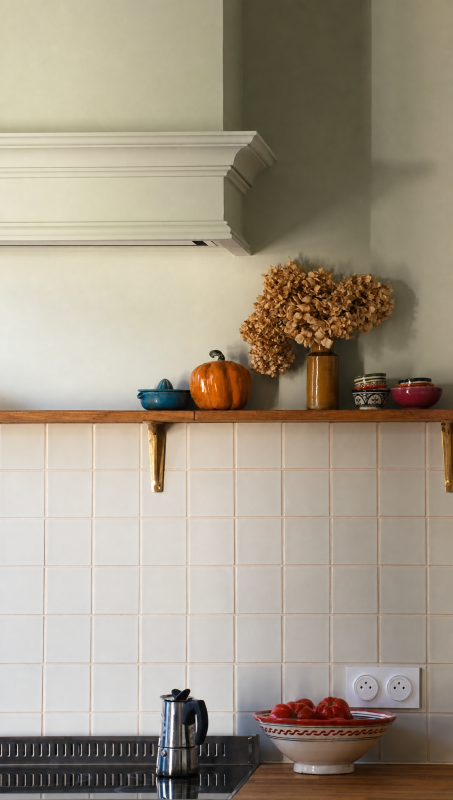
Seville oranges are in season in January and February, and making marmalade is one of those deeply satisfying activities that produces a tangible, beautiful result in just a few hours. The kitchen filled with the scent of citrus and sugar, the jars lined up on the counter looked like something from a magazine, and we had weeks worth of homemade marmalade to enjoy on our morning toast. It was a therapeutic afternoon that had nothing to do with insulation or roof supports, and that was exactly the point.
We think this is an important message for anyone in the middle of a long renovation: do not let the project consume your entire life. Make time for the things that bring you joy and remind you why you chose to live in this beautiful place. Cook a proper meal. Tend the garden. Sit in the evening light with a glass of wine. These are not distractions from the renovation; they are the reason for it.
What We Have Learned About Managing Difficult Phases
Every renovation has its difficult phases, and after several years of working on La Chartreuse, we have developed some strategies for getting through them without losing our minds. Here is what works for us:
Accept the pace. Some phases of a renovation are inherently slow. Fighting against that reality only leads to frustration and mistakes. When we accepted that the roof supports were going to take weeks rather than days, we stopped feeling behind and started feeling methodical.
Celebrate progress, not completion. When you are only 25 percent through a task, it is easy to focus on the 75 percent still remaining. We try to flip that perspective and appreciate what we have accomplished rather than dwelling on what is left. Every support we install is one step closer to a finished ceiling.
Vary your work. Spending every single day on the same painstaking task is a recipe for burnout. We try to mix in different types of work, whether that is a small project like the bathroom shelves, some garden maintenance, or even administrative tasks. The variety keeps things fresh and prevents the monotony from becoming oppressive.
Document everything. Filming our progress for the YouTube channel is work in itself, but it also serves as a record that we can look back on. When we are feeling discouraged, we can watch footage from a few months ago and see how far we have come. The visual evidence of progress is incredibly motivating.
Lean on your community. We are incredibly fortunate to have a community of followers who understand what we are going through. The comments, messages, and encouragement we receive make a genuine difference on the hard days. If you are renovating and not sharing your journey somewhere, even just with friends and family, we would strongly encourage it. Having people who care about your progress and cheer you on is more valuable than any tool in your kit.
What Comes Next
Looking ahead, our priority is finishing the roof supports so that we can move on to installing the insulation. Once the insulation is in place and the plasterboard is up, the upper floor will start to feel like actual rooms rather than a construction zone, and that will be a major milestone.
We are also keeping an eye on the weather forecast, hoping for a dry spell that will let us tackle some exterior work that has been on the list for months. There are tiles to replace, stonework to repoint, and guttering to repair, all of which require dry conditions and moderate temperatures.
We will continue to share every step of this journey, the good days and the bad, because we believe that honest documentation of what renovation actually looks like is more valuable than a curated highlight reel. If our experience can help even one person feel less alone in their own renovation struggles, then the effort of documenting it all is worthwhile.
If you have not already seen the latest video, we would love for you to watch it. It captures the full reality of this fortnight: the rain, the twisted beams, the insulation scramble, the bathroom shelves, and yes, the marmalade. It is all there, and we think it is one of our most honest episodes yet.
Thank you for being part of this journey with us. Your support means more than you know, especially during the weeks when everything feels like an uphill battle. We will be back soon with more updates, and hopefully, some better weather.
A bientot,
Hugo and Romy